

According To Cohen's Conventions For Effect Size, How Do You Describe An Effect Size When D = 0.50?
What is Event Size and Why Does It Matter?
Effect size tells you how meaningful the relationship between variables or the difference betwixt groups is. It indicates the practical significance of a research outcome.
A large effect size means that a inquiry finding has applied significance, while a pocket-size effect size indicates limited applied applications.
Why does effect size affair?
While statistical significance shows that an result exists in a study, applied significance shows that the event is large enough to be meaningful in the real world. Statistical significance is denoted past p-values, whereas practical significance is represented by result sizes.
Statistical significance alone tin be misleading because it's influenced past the sample size. Increasing the sample size always makes information technology more than likely to discover a statistically significant upshot, no matter how pocket-size the result truly is in the real world.
In contrast, event sizes are contained of the sample size. Merely the information is used to calculate effect sizes.
That's why it's necessary to report effect sizes in research papers to indicate the applied significance of a finding. The APA guidelines require reporting of effect sizes and conviction intervals wherever possible.
Later on 6 months, the hateful weight loss (kg) for the experimental intervention group (M = x.6, SD = half dozen.7) was marginally higher than the mean weight loss for the control intervention group (G = x.5, SD = 6.viii).
These results were statistically significant (p = .01). Nonetheless, a departure of only 0.1 kilo between the groups is negligible and doesn't actually tell you lot that i method should exist favored over the other.
Calculation a measure out of applied significance would show how promising this new intervention is relative to existing interventions.
How do you calculate effect size?
There are dozens of measures for effect sizes. The nearly mutual upshot sizes are Cohen's d and Pearson'due south r. Cohen'due south d measures the size of the difference betwixt 2 groups while Pearson's r measures the strength of the relationship between two variables.
Cohen's d
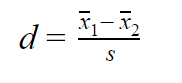
Cohen'due south d is designed for comparing ii groups. It takes the departure between two ways and expresses it in standard difference units. It tells you how many standard deviations lie between the 2 means.
| Cohen's d formula | Explanation |
|---|---|
 |
|
The choice of standard deviation in the equation depends on your research design. You can utilise:
- a pooled standard departure that is based on data from both groups,
- the standard divergence from a control group, if your blueprint includes a control and an experimental group,
- the standard deviation from the pretest data, if your repeated measures design includes a pretest and posttest.
d = (x̄ 1 − x̄ 2) ÷ due south
d = (10.vi − 10.5 )÷ 6.eight =0.015
With a Cohen's d of 0.015, in that location's express to no applied significance of the finding that the experimental intervention was more than successful than the command intervention.
Pearson's r
Pearson's r , or the correlation coefficient, measures the extent of a linear human relationship between ii variables.
The formula is rather circuitous, so it's all-time to employ a statistical software to calculate Pearson's r accurately from the raw data.
| Pearson'due south r formula | Caption |
|---|---|
| |
|
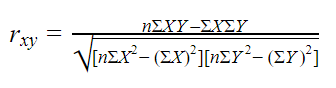
The primary thought of the formula is to compute how much of the variability of ane variable is adamant by the variability of the other variable.
Pearson's r is a standardized scale to measure correlations betwixt variables—that makes information technology unit-gratis. You lot can directly compare the strengths of all correlations with each other.
Ane caveat is that Pearson'south r, similar Cohen's d, can only exist used for interval or ratio variables. Other measures of issue size must be used for ordinal or nominal variables.
Receive feedback on language, construction and formatting
Professional editors proofread and edit your paper past focusing on:
- Academic style
- Vague sentences
- Grammar
- Mode consistency
See an case

How practice you know if an event size is small or big?
Event sizes can be categorized into small, medium, or big according to Cohen's criteria.
Cohen's criteria for small, medium, and large furnishings differ based on the outcome size measurement used.
| Effect size | Cohen's d | Pearson's r |
|---|---|---|
| Small | 0.2 | .1 to .3 or -.one to -.3 |
| Medium | 0.5 | .3 to .5 or -.3 to -.v |
| Big | 0.8 or greater | .5 or greater or -.5 or less |
Cohen's d can take on whatsoever number between 0 and infinity, while Pearson's r ranges betwixt -1 and 1.
In general, the greater the Cohen's d, the larger the effect size. For Pearson's r, the closer the value is to 0, the smaller the effect size. A value closer to -1 or 1 indicates a college effect size.
Pearson'sr also tells you something about the direction of the relationship:
- A positive value (east.g., 0.7) means both variables either increase or decrease together.
- A negative value (east.thou., -0.vii) means one variable increases as the other one decreases (or vice versa).
The criteria for a pocket-sized or large effect size may also depend on what'southward commonly establish research in your item field, then exist sure to cheque other papers when interpreting effect size.
When should yous summate effect size?
Information technology'southward helpful to calculate issue sizes even before you brainstorm your study every bit well every bit after you complete data collection.
Before starting your study
Knowing the expected outcome size means you lot can figure out the minimum sample size you lot need for enough statistical power to detect an event of that size.
In statistics, power refers to the likelihood of a hypothesis test detecting a truthful effect if there is one. A statistically powerful test is more likely to reject a false negative (a Type II error).
If you don't ensure enough power in your study, you may non be able to detect a statistically significant outcome even when information technology has practical significance. In that case you don't decline the null hypothesis, even though there is an actual effect.
By performing a power analysis, you can use a ready effect size and significance level to make up one's mind the sample size needed for a certain power level.
Afterward completing your written report
Once you've nerveless your data, you lot can calculate and report actual effect sizes in the abstract and the results sections of your paper.
Issue sizes are the raw information in meta-analysis studies because they are standardized and like shooting fish in a barrel to compare. A meta-analysis tin combine the event sizes of many related studies to get an idea of the boilerplate effect size of a specific finding.
Just meta-assay studies tin can also go one step further and besides suggest why event sizes may vary beyond studies on a single topic. This can generate new lines of inquiry.
Oft asked questions nearly effect size
- What is effect size?
-
Effect size tells you how meaningful the relationship between variables or the divergence between groups is.
A large effect size ways that a research finding has practical significance, while a small issue size indicates limited applied applications.
- How practise I calculate effect size?
-
At that place are dozens of measures of effect sizes. The near common effect sizes are Cohen's d and Pearson'due south r. Cohen'south d measures the size of the difference betwixt two groups while Pearson's r measures the forcefulness of the relationship between two variables.
- What is statistical power?
-
In statistics, power refers to the likelihood of a hypothesis examination detecting a true effect if in that location is one. A statistically powerful examination is more than probable to reject a simulated negative (a Type II error).
If y'all don't ensure enough ability in your written report, you lot may not exist able to detect a statistically significant outcome even when it has applied significance. Your study might non have the power to answer your research question.
Is this article helpful?
Yous have already voted. Thank you :-) Your vote is saved :-) Processing your vote...

According To Cohen's Conventions For Effect Size, How Do You Describe An Effect Size When D = 0.50?,
Source: https://www.scribbr.com/statistics/effect-size/
Posted by: mantzhaternithere1988.blogspot.com
0 Response to "According To Cohen's Conventions For Effect Size, How Do You Describe An Effect Size When D = 0.50?"
Post a Comment